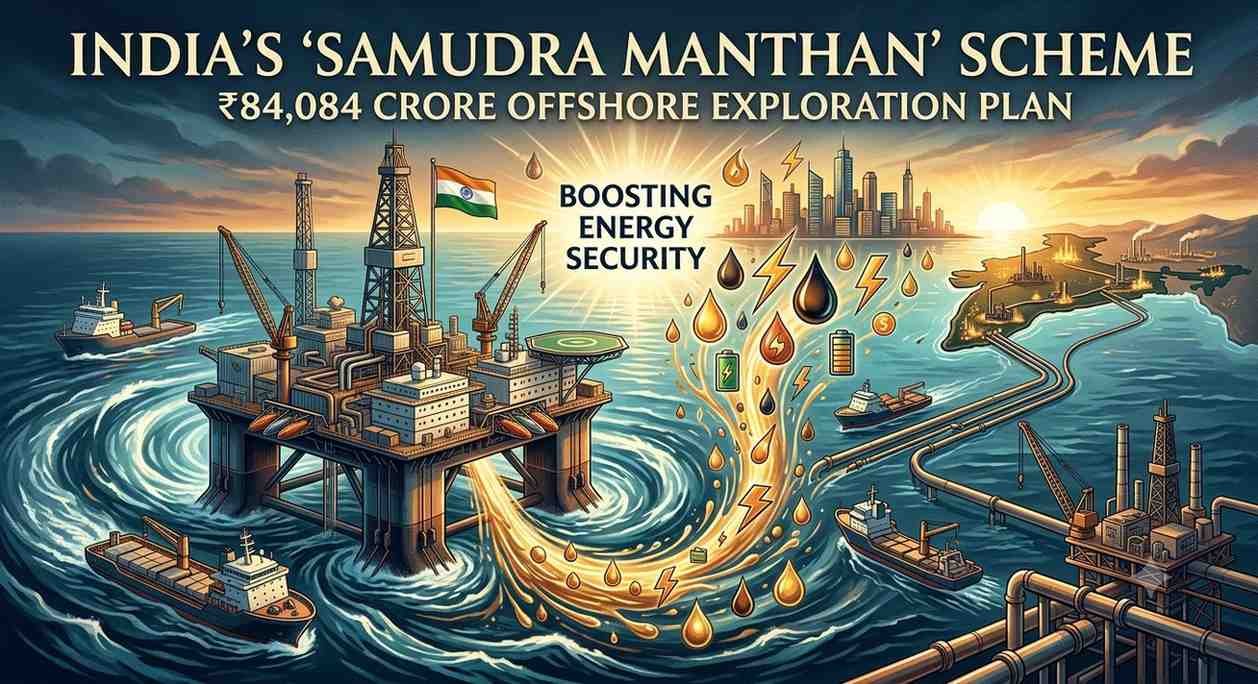
India’s ‘Samudra Manthan’ Scheme: How the ₹84,084 Crore Offshore Exploration Plan Works
In a significant step aimed at improving the country’s energy security, the Union Cabinet has given its approval to the Samudra Manthan National Offshore Exploration Scheme, which has a budget of ₹84,084 crore. The scheme is intended to prompt companies to explore oil and natural gas reserves in India’s deepwater and ultra-deepwater offshore areas by having them share a large part of the financial risk.
At a time when global energy markets are still experiencing uncertainty as a result of geopolitical tensions and supply disruptions, it is all the more important to increase domestic energy production.
Why India Introduced the Samudra Manthan Scheme
India continues to be greatly reliant on imported crude oil and natural gas in order to meet its increasing energy requirements.
According to government data:
About 88 per cent of the crude oil needed in India is obtained by importing it.
About half of the natural gas consumption in the country is obtained from overseas markets.
Natural gas is of great importance in the production of fertilisers, in the generation of electricity, in the production of compressed natural gas (CNG), and in the supply of gas for cooking through pipes.
The recent disruptions to the global supply have once again shown how important it is to boost domestic production and cut down on reliance on imported fuel.
Government to Share Exploration Risk
A major difficulty in offshore exploration is the extremely high cost together with the uncertainty attached to drilling wells, since companies have to make investments in the region of billions without any assurance that they will find oil or gas reserves which can be exploited commercially.
To encourage exploration, the government will provide financial assistance covering:
50% of the drilling cost, or
The amount will not exceed ₹650 crore per exploration well, whichever figure is lower.
Financial assistance will be made available for 60 deepwater and ultra-deepwater exploration wells which are planned over the next five years.
This method greatly lessens the financial strain on companies involved in exploration and at the same time promotes investment in those offshore regions which have hitherto been little explored.
Whom can one get benefit from the scheme?
The Samudra Manthan scheme will be available to companies holding offshore exploration blocks under:
The earlier rounds of the Open Acreage Licensing Programme (OALP).
The current bidding process for OALP.
Companies that are eligible can claim government aid for exploration wells which meet the requirements of the scheme.
The government also hopes that the initiative will draw in global energy companies to take part in India’s offshore exploration sector.
How the ₹84,084 Crore Budget Will Be Utilised
The entire amount provided by the scheme has been spread out among various components designed for supporting exploration and infrastructure development.
Deepwater Exploration
₹43,200 crore is being allocated for the drilling of about 60 exploration wells in deepwater and ultra-deepwater areas up to 2031.
Seismic and Geological Surveys
The amount of ₹28,534 crore will be used to carry out advanced offshore seismic and geological surveys in order to locate areas that have high exploration potential prior to drilling starting.
Common Infrastructure
The government has earmarked ₹10,000 crore for developing shared offshore infrastructure, including:
Subsea pipelines
Oil and gas receiving terminals
Processing facilities
It is anticipated that shared infrastructure will reduce the costs of the projects and lead to better operational efficiency for a number of operators.
Manufacturing and Service Hubs
₹2,000 crore more will be used to promote the development of oil and gas manufacturing and service areas, thus reinforcing India’s offshore energy ecosystem.
Common Hub Infrastructure to Reduce Costs
A major feature of the scheme is the establishment of the Common Hub Infrastructure (CHI).
Rather than each exploration company having to construct its own pipelines and processing facilities, several operators will be able to use the same infrastructure.
This model is expected to:
Lower project development costs.
Improve offshore logistics.
Speed up commercial production.
Make it so that smaller discoveries are economically viable.
Make better use of the offshore engineering resources.
The use of a shared infrastructure method could make deepwater projects more appealing to both domestic and international investors.
Potential Impact on India’s Energy Imports
Experts in the industry think that the scheme might lead to a higher level of domestic oil and gas production in the long run.
It is estimated that the initiative could increase India’s annual energy output by about 10 to 15 million tonnes of oil equivalent (MTOE).
Although this could decrease India’s reliance on imported oil and gas by about 3 to 5 per cent, experts point out that offshore exploration is still a long-term affair with uncertain results.
It is not anticipated that all exploration wells will lead to the discovery of hydrocarbons which can be pursued commercially.
Building on Earlier Energy Reforms
The Samudra Manthan scheme forms part of India’s wider initiative to modernise its policies regarding hydrocarbon exploration.
Over the past several years, the government has introduced multiple reforms, including:
Hydrocarbon Exploration and Licensing Policy (HELP)
Open Acreage Licensing Programme (OALP)
Revenue Sharing Contracts
Uniform licensing framework
Marketing and pricing freedom for producers
The reforms were even more strengthened by the Oilfields (Regulation and Development) Amendment Act of 2025, since this act promotes greater private involvement in the exploration of oil and gas.
Long-Term Vision for Offshore Exploration
The government believes that the Samudra Manthan initiative will lead to an increase in exploration activities in India’s offshore basins, stimulate greater investment by both domestic and international companies, and enhance the nation’s long-term energy security.
The scheme seeks to make offshore oil and gas exploration more attractive by sharing the risks involved and establishing common infrastructure, at the same time helping to achieve India’s aim of reducing its dependence on imported energy.