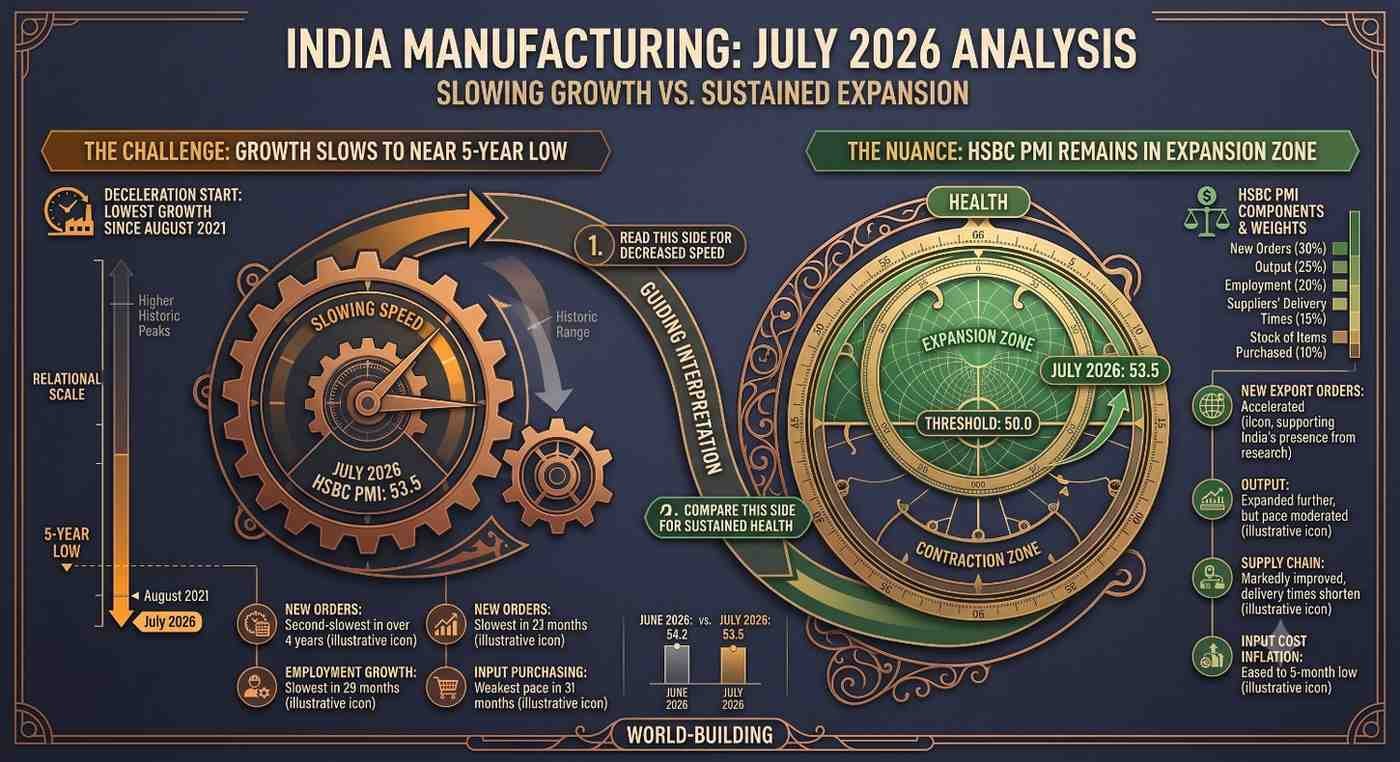
According to the HSBC India Manufacturing Purchasing Managers’ Index (PMI) report released on Monday, India’s manufacturing sector recorded its weakest growth in almost five years in July, the factory activity level still remaining in positive territory.
The seasonally adjusted HSBC India Manufacturing PMI dropped to 53.5 in July from 54.2 in June, which was its lowest level since August 2021. Although it had declined, the index still stayed above the 50-point figure, showing that manufacturing activity had continued to expand, if at a slower rate.
Domestic demand softens, exports remain resilient
The survey indicated that although demand was generally supportive, the growth in new orders, input purchases and employment slowed down during the month.
The report states that manufacturers have on going benefited from strong demand, this having led to higher levels of production. Yet the rate of growth has declined in a number of key areas, such as total sales, the procurement of raw materials and the number of people employed.
Exports were a positive point. Even though domestic demand was weaker, orders from abroad grew, with firms noting higher sales in countries including Canada, Egypt, Indonesia, Kenya, Nepal, South Africa, Thailand and the UAE.
Factory output also kept on increasing, although the rate of expansion was one of the weakest ever recorded since mid-2022.
Supply chains improve, inventories rise
The survey showed that there was some further improvement in supply chain conditions in July, since manufacturers noted that the delivery of inputs had become faster, supplier delivery times having improved at one of the quickest rates recorded in the history of the survey.
Companies also carried out further inventory rebuilding, which caused their stocks of both raw materials and finished goods to rise.
Inflation trends mixed
With regard to the findings, Pranjul Bhandari, HSBC’s Chief India Economist, stated that the improvement in supplier delivery times indicated a reduction in supply chain bottlenecks, although fresh geopolitical tensions in the Middle East could pose risks to these gains.
She observed that higher factory output and export orders indicated that overseas demand was resilient.
Bhandari also pointed out a change in pricing trends since input cost inflation had fallen to a five-month low whilst output price inflation had picked up, indicating that manufacturers are increasingly passing on their higher costs to customers in order to protect their profit margins.
Hiring slows, confidence improves
Employment growth declined for the third month in a row, with hiring taking place at the weakest rate during the current streak of 29 consecutive months of job creation in the manufacturing sector.
Even though transportation costs stayed high, the overall rate of inflation in input costs decreased during the month.
Even though there had been a slowdown in activity, business confidence rose from the low level seen in June. The manufacturers felt optimistic that the growing demand, the ongoing infrastructure spending and the rise in new customer inquiries would help to drive growth in the coming months.
The manufacturing purchasing managers’ index produced by S&P Global for HSBC India is derived from responses received from about 400 manufacturing companies in the country and is generally considered to be a major indicator of the condition of India’s factory sector.