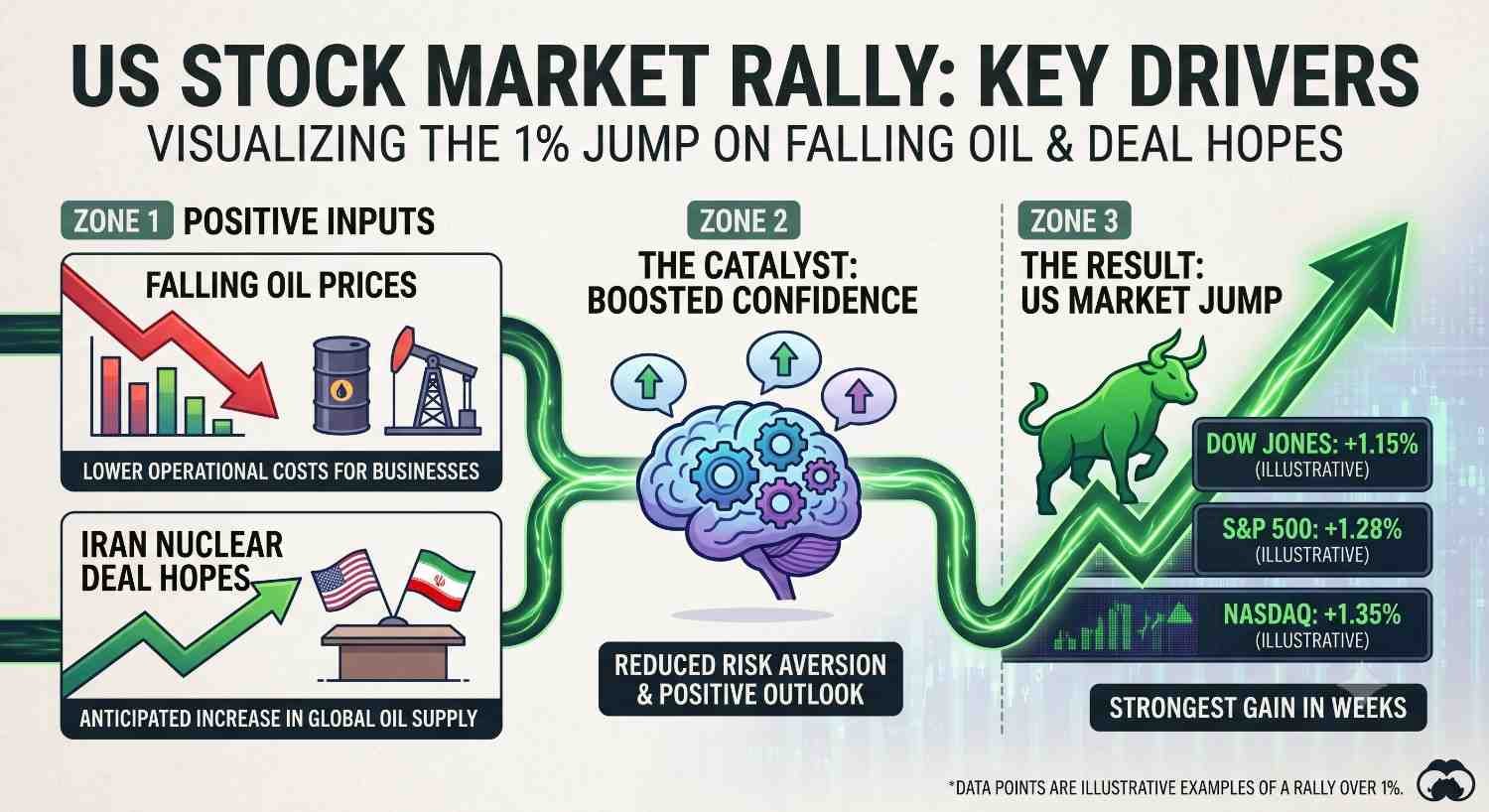
On Monday Wall Street showed a vigorous recovery with the major US stock indexes increasing by more than 1 per cent due to falling oil prices and the prospect of a diplomatic breakthrough with Iran, which boosted investors’ mood.
The S&P 500 rose by 1 per cent, continuing its recovery following the turbulent July which was characterised by steep fluctuations in the market. The Dow Jones Industrial Average increased by 624 points, that is 1.2 per cent, and the Nasdaq Composite also made a gain of more than 1 per cent.
The rally occurred following a sharp fall in crude oil prices, which reduced worries that higher energy costs could lead to inflation and cause the US Federal Reserve to maintain high interest rates for a longer period.
After US President Donald Trump said over the weekend that he had decided not to carry out new military strikes on Iran in response to appeals from his regional allies, Brent crude, which is the global oil benchmark, dropped 4.9% to $83.65 per barrel. This development increased expectations of a reduction in geopolitical tensions in the Middle East and improved the outlook for energy supplies.
Oil markets have shown a high level of volatility over the past few weeks. In the previous month the price of Brent crude oil fluctuated between $72 and $102 per barrel as investors responded to the developments concerning the Iran conflict and to the uncertainty about shipping via the Persian Gulf.
The drop in oil prices also reduced inflation expectations, which caused US Treasury yields to fall. The yield on the benchmark 10-year Treasury note decreased to 4.68% from 4.75% on Friday. Yet it was still well above the 3.97% level that had been recorded before the Iran conflict started.
Investors are now growing concerned about higher bond yields since such yields raise the cost of borrowing for both consumers and businesses and also place pressure on stock prices. Mortgage rates in the United States have already reached their highest point in a year.
The market rally was led by companies that enjoyed lower fuel costs. United Airlines increased in value by 5.6 per cent, American Airlines gained 5.7 per cent, and Norwegian Cruise Line Holdings rose by 5.4 per cent as investors welcomed the fall in energy prices.
At the same time, semiconductor stocks were still under pressure from sellers due to concerns that the rapid growth spurred by artificial intelligence might not be sustainable in the long term. Since investors are wary of the possibility that AI will not achieve the anticipated improvements in productivity and profitability, technology companies may reduce their heavy spending on data centres, thus lowering demand for advanced chips.
Micron Technology’s share price dropped by 4.9 per cent, making it one of the principal contributors to the decline in the S&P 500, although the stock is still up by more than 170 per cent for the year. Advanced Micro Devices (AMD) also fell by 2.7 per cent, which reduced its year-to-date gain to 116 per cent.
The Asian markets also experienced steep fluctuations. South Korea’s Kospi index dropped by 5.1 per cent, reversing the record 17.9 per cent jump which had occurred on Friday, since AI-related shares were once again under pressure. The index is greatly influenced by the big technology companies Samsung Electronics and SK Hynix.
In Japan the Nikkei 225 fell by 0.9 per cent following the fact that both the United States and Japan had confirmed their intention to co-ordinate efforts to support the Japanese yen. Although a stronger yen might help to reduce inflation in Japan, it could also have a negative effect on the country’s export-oriented economy by making its goods more expensive abroad.
Generally, investors were pleased by the fall in oil prices and the indication of lower geopolitical risks, although worries regarding inflation, interest rates and the future of AI-driven technology stocks still influence market sentiment.